
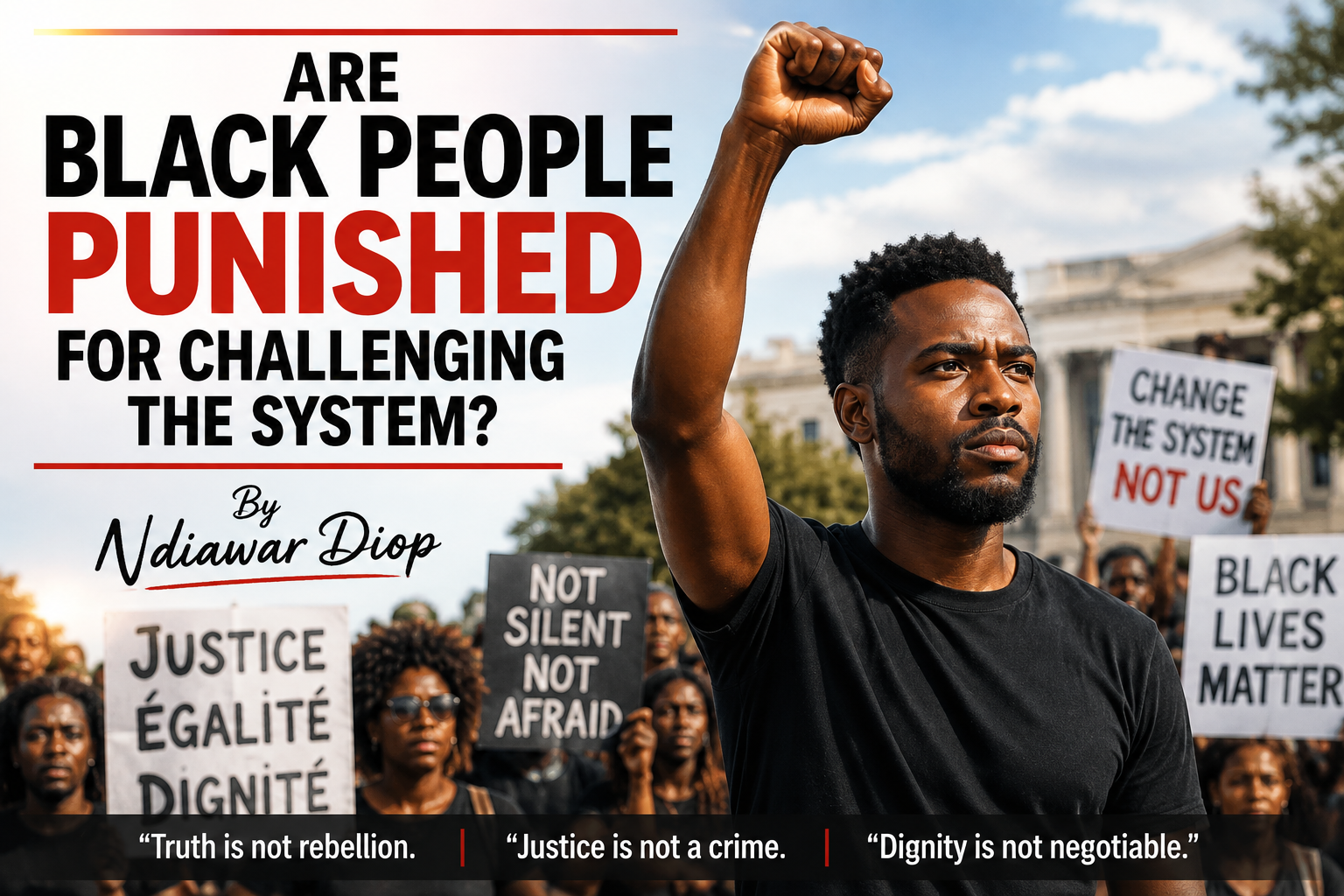
Are Black People Punished for Challenging the System?
– By Ndiawar Diop
There is a question that history keeps placing before us, even when societies would rather avoid it:
What happens to Black people who refuse to accept the system as it is?
Is the price of challenging established power sometimes higher when the challenger is Black?
Is dissent treated differently when it comes from people who have historically been excluded from the rooms where decisions are made? And when a Black person questions authority, exposes injustice, refuses political obedience, or simply insists on dignity, does society hear a voice of conscience, or see a threat that must be contained?
These questions are uncomfortable. But uncomfortable questions are often the beginning of meaningful conversations.
To ask whether Black people are punished for challenging the system is not to claim that every Black person who faces consequences is a victim of racism, nor that every institution is deliberately conspiring against Black people. Such simplistic explanations would be unfair and intellectually dangerous.
The deeper question is about patterns, power and perception.
When resistance becomes a problem
Every society has systems.
There are political systems, economic systems, judicial systems, educational systems, corporate systems and social hierarchies.
These structures can provide order and stability, but they can also protect people who already possess influence.
Those who benefit from a system rarely experience it as oppressive.
The person sitting comfortably inside the house may see no reason to question the architecture. The person standing outside in the rain may see every crack in the walls.
Throughout history, many Black people have challenged systems that were presented as normal, inevitable or untouchable.
From abolitionists to civil rights activists, from labor organizers to journalists, from academics to artists, from community leaders to ordinary citizens, Black resistance has repeatedly forced societies to confront contradictions between their ideals and their realities. And resistance has often carried a price.
The punishment has not always been imprisonment or physical violence.
Sometimes it has been humiliation. Sometimes professional exclusion.
Sometimes economic retaliation. Sometimes character assassination.
Sometimes surveillance. Sometimes political isolation.
And sometimes the most effective punishment is simply to make a person irrelevant.
Silence them. Discredit them. Isolate them. Make people afraid to stand beside them.
The politics of being “difficult”
There is another form of punishment that is less visible.
It is the labeling of the Black person who refuses to conform.
A Black person who remains silent may be described as respectable.
A Black person who agrees may be called reasonable.
A Black person who succeeds within the established rules may be celebrated as an example of progress.
But what happens when that same person starts asking difficult questions?
What happens when he or she says: This institution is failing us.
What happens when they ask: Why are the rules different for the powerful?
What happens when they refuse to applaud political leaders simply because those leaders belong to the same racial community?
What happens when they challenge corruption, hypocrisy, discrimination or economic exploitation?
Suddenly, the language can change.
The person becomes “angry.”
“Uncooperative.”
“Divisive.”
“Dangerous.”
“Radical.”
“Problematic.”
Sometimes the criticism is legitimate. Sometimes it is not. But the important point is that the content of a person’s argument can become secondary to the discomfort caused by the person making it. The Black community can also punish its own challengers This conversation must be honest enough to look inward. The problem is not always “the system” versus Black people.
Black communities themselves contain political interests, social hierarchies, economic elites and powerful institutions. Black leaders can become part of the very structures they once promised to challenge. And Black people can sometimes punish other Black people for challenging those structures.
Why?
Because power creates its own logic.
Once an individual gains influence, criticism can become threatening. Loyalty can become more valuable than truth. Political affiliation can become more important than principle. A person who once fought against injustice can eventually become defensive of his own position.
This is one of the great tragedies of political life:
Yesterday’s revolutionary can become tomorrow’s establishment. That is why the struggle for justice cannot simply be about changing the color of the people occupying positions of power. It must also be about changing the relationship between power and accountability. The danger of confusing criticism with betrayal. One of the greatest weaknesses of any movement is the inability to tolerate internal criticism.
When a political party, organization, religious community, cultural movement or social cause begins treating every disagreement as betrayal, it stops growing.
A healthy movement should not fear questions.
It should welcome them.
A Black person who criticizes a Black president is not necessarily anti-Black.
A Black citizen who challenges a Black political party is not necessarily working for its opponents.
A Black journalist who investigates Black leaders is not necessarily betraying the community.
And a Black intellectual who questions popular opinion should not automatically be accused of serving someone else’s agenda. Accountability is not betrayal. Sometimes the most patriotic person in the room is the one courageous enough to say, We are wrong.
History teaches us to examine the messenger, and the message
There is another danger. Because Black people have experienced genuine discrimination and injustice, there is sometimes a temptation to interpret every setback as proof of racial persecution.
We should resist that temptation.
Justice requires evidence.
Not every arrest is racism.
Not every failed business is discrimination.
Not every political defeat is a conspiracy.
Not every criticism is an attack.
But the opposite mistake is equally dangerous: pretending that racism, institutional discrimination and unequal treatment have disappeared simply because the law now formally condemns them.
Both extremes prevent honest analysis.
The mature position is to ask:
What happened?
Who made the decision?
What rules were applied?
Were those rules applied consistently?
Who benefited?
Who suffered?
Would the same decision have been made under the same circumstances if the person were from a different racial or social background?
Those are questions worth investigating. Challenging the system requires courage and responsibility. There is nothing inherently virtuous about being rebellious. Not every challenger is right.
Sometimes systems exist for good reasons. Laws protect people. Institutions provide stability. Rules can prevent abuse. The objective should therefore not be to destroy every system. The objective should be to challenge systems that have become unjust, discriminatory, corrupt or incapable of correcting themselves. And those who challenge them must accept responsibility for their own conduct.
Truth does not need exaggeration.
Justice does not require hatred. Resistance does not require violence. And Black empowerment should never mean replacing one form of domination with another. The strongest challenge to an unjust system is not chaos. It is truth, competence, organization, courage and persistence.
Why this question still matters
Across the world, Black communities continue to debate representation, policing, political power, economic inequality, immigration, education, media ownership and access to opportunity. But representation alone is not enough. Having a Black face in a powerful office does not automatically make the institution just.
Having Black executives in corporations does not automatically eliminate economic inequality.
Having Black politicians does not automatically mean Black communities are politically empowered.
Having Black journalists does not guarantee independent journalism.
The real question is not simply:
Who is sitting at the table?The deeper question is:
Who controls the table, who sets the rules, who benefits from those rules, and who is allowed to challenge them?
That is where the conversation becomes serious.
We should not be afraid of the question
Are Black people punished for challenging the system?
Sometimes, history strongly suggests that people who challenge entrenched power can pay a price and race can influence how dissent is perceived and treated.
But the answer cannot simply be “yes.”
The better answer is:
Let us examine the evidence.
Let us examine institutions.
Let us examine laws.
Let us examine media narratives.
Let us examine political parties.
Let us examine economic structures.
Let us examine our own communities.
And, above all, let us examine ourselves.
Because the greatest victory is not merely to have the freedom to challenge the system. The greatest victory is to build a society in which challenging injustice is no longer treated as an act of rebellion, but as an essential part of democracy.
A society becomes stronger when citizens can question authority without fear.
A political movement becomes stronger when its members can disagree without being enemies.
A community becomes stronger when it can criticize itself without destroying itself.
And a democracy becomes stronger when power understands one fundamental truth:
No authority is so powerful that it should be above questions.
Perhaps the real issue, then, is not whether Black people are punished for challenging the system.
Perhaps the question we should all be asking is much bigger:
Why does any system become so afraid of those who dare to question it?
By Ndiawar Diop