Mass Incarceration in America: When Justice Is Not Equal for Everyone
By Ndiawar Diop Cet article aborde la question de la Mass Incarceration in America: When Justice Is Not Equal for Everyone.
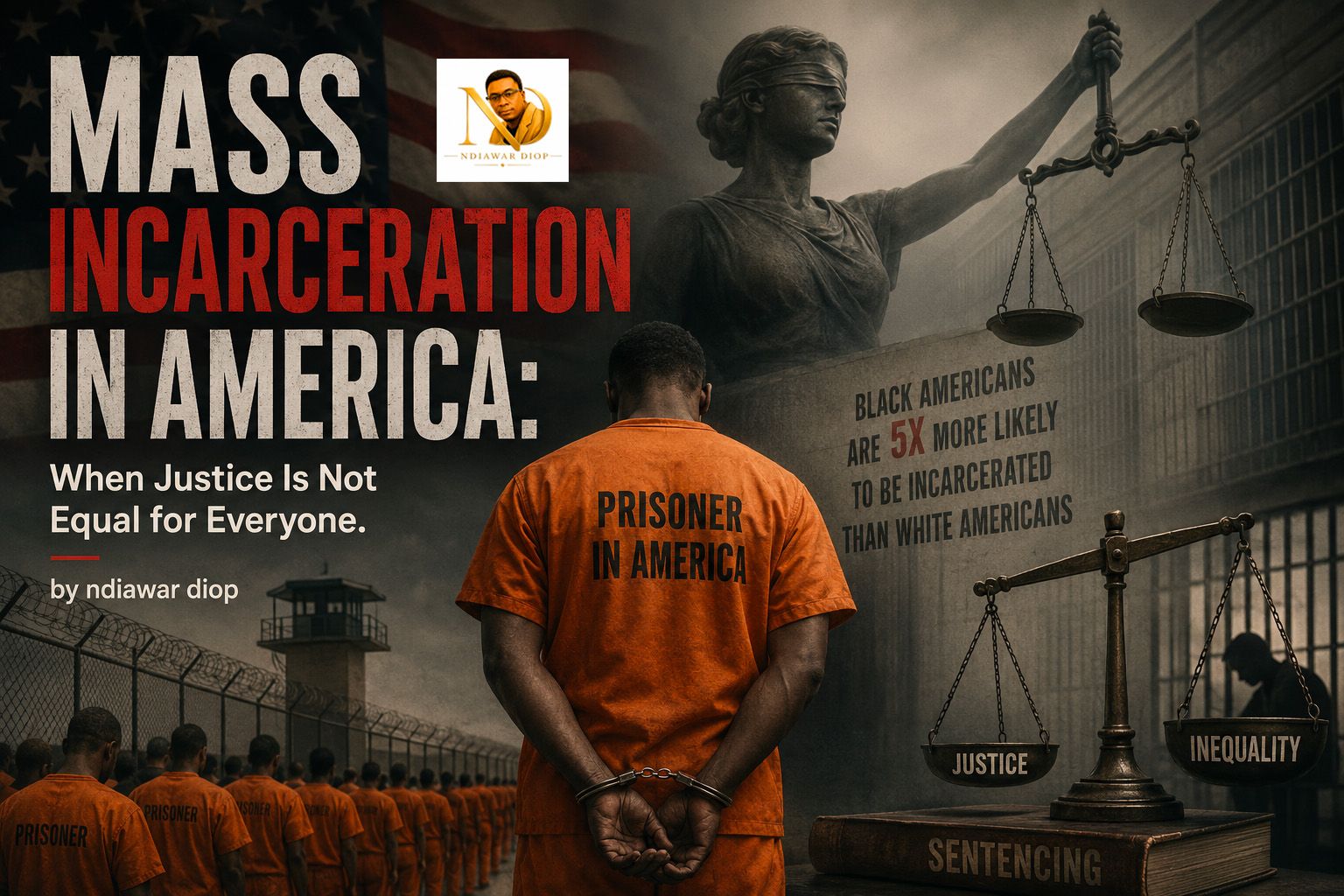
The United States proudly presents itself as the land of freedom, democracy, and equal justice under the law. Yet behind these powerful ideals lies a troubling reality. America imprisons more people than any other democratic nation, and the burden of this system falls disproportionately on Black and Hispanic communities.
This is not simply a prison issue. It begins with police encounters, continues through the courts, and often ends with long prison sentences that affect entire families and communities for generations.
The question every American should ask is simple: Can justice truly be called justice if it does not affect all communities equally?
America and the Era of Mass Incarceration
Beginning in the 1970s and accelerating during the 1980s and 1990s, the United States adopted increasingly tough criminal justice policies. Mandatory minimum sentences, « three-strikes » laws, and the War on Drugs dramatically increased the prison population.
Today, although incarceration rates have declined from their historic peak, the United States still maintains one of the highest incarceration rates in the world. Millions of Americans have spent time in jail or prison, and millions more live with the long-term consequences of a criminal record.
A System That Does Not Affect Every Community Equally
Statistics consistently show that Black Americans are imprisoned at significantly higher rates than White Americans. Hispanic Americans are also overrepresented in many parts of the criminal justice system compared with their share of the population, although the size of disparities varies by offense, state, and stage of the process.
These disparities appear at multiple stages:
- Police stops and searches.
- Arrests.
- Charging decisions by prosecutors.
- Plea bargaining.
- Sentencing.
- Parole decisions.
Researchers continue to debate the exact causes of these differences, but many studies conclude that historical inequalities, neighborhood conditions, policing practices, sentencing laws, and discretionary decisions throughout the justice system all contribute.
The War on Drugs Changed America
Perhaps no policy illustrates mass incarceration more than the War on Drugs.
Studies have found that drug use occurs across racial groups at broadly comparable rates for many substances. However, enforcement has often been concentrated in poorer urban neighborhoods, leading to far higher arrest and incarceration rates for Black and Latino communities.
For decades, harsh sentencing laws for crack cocaine—used more heavily in some Black communities—were far more severe than those for powder cocaine, a disparity that many legal scholars and policymakers later criticized as unfair. Although Congress has reduced that sentencing gap, many believe its long-term effects are still being felt today.
Beyond Prison Walls
Mass incarceration affects far more than the person who is sentenced.
Children grow up without parents.
Families lose income.
Communities lose workers, mentors, and leaders.
Former prisoners often struggle to find employment, housing, education, and financial opportunities because of their criminal records.
These barriers increase the risk of poverty and can contribute to repeat involvement with the justice system, creating a cycle that is difficult to escape.
The Role of Poverty
Race is only one part of the conversation.
Poverty also plays a major role.
People with limited financial resources often cannot afford experienced lawyers. Many rely on overworked public defenders handling dozens or even hundreds of cases.
Some defendants plead guilty—not because they are guilty—but because they fear receiving much longer sentences if they go to trial and lose.
Justice should never depend on the size of someone’s bank account.
Police and Community Trust
Most police officers serve honorably and put their lives at risk every day to protect their communities.
At the same time, numerous studies have documented racial disparities in police stops, searches, and arrests in many jurisdictions. Building trust between law enforcement and communities requires transparency, accountability, and strong relationships.
Communities are safest when residents trust the police enough to report crimes, cooperate with investigations, and believe they will be treated fairly.
Reform Is Possible
Across the political spectrum, many Americans now agree that some aspects of the criminal justice system need reform.
Some states have:
- Reduced mandatory minimum sentences.
- Expanded diversion programs for nonviolent offenders.
- Increased access to drug treatment and mental health services.
- Improved reentry programs.
- Expanded sentencing review in some cases.
Organizations across the political spectrum argue that reducing unnecessary incarceration can improve public safety while lowering costs and strengthening communities.
Justice Should Mean Equal Justice
No justice system will ever be perfect.
Crime exists.
Victims deserve protection.
Dangerous offenders should be held accountable.
But justice must also be fair, impartial, and worthy of public confidence.
A person’s race, neighborhood, or economic status should never determine how they are treated by police, prosecutors, judges, or juries.
America has made important progress over the past several decades, but significant challenges remain.
The true measure of a democracy is not how it treats its strongest citizens. It is how it treats its weakest, its poorest, and its most vulnerable.
The conversation about mass incarceration is not about excusing crime.
It is about ensuring that justice belongs equally to everyone.
Only then can America fully live up to its promise that all people are equal before the law.
Ndiawar Diop