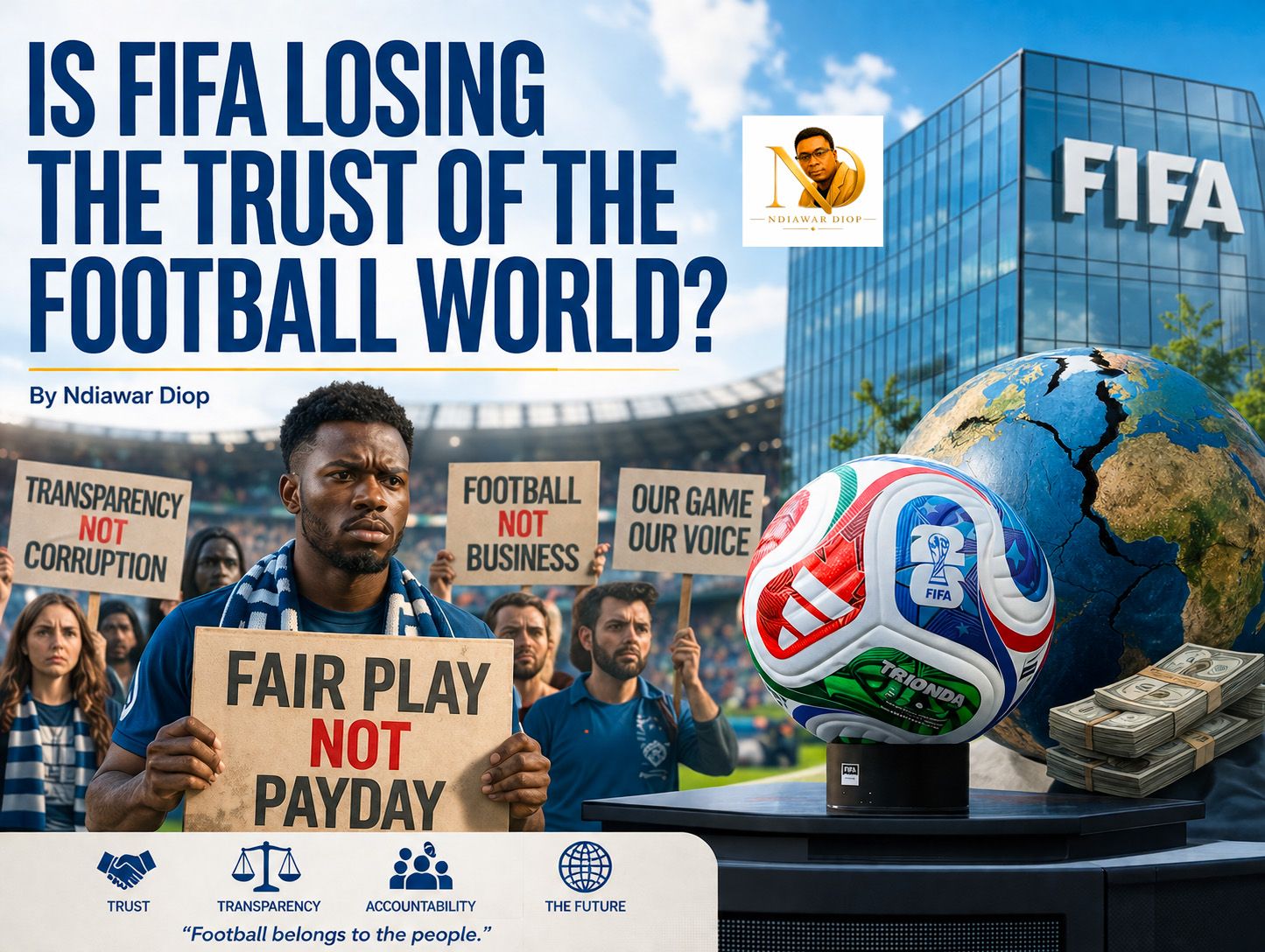
Is FIFA Losing the Trust of the Football World?
By Ndiawar Diop
Football is called the beautiful game because it is supposed to unite people under one simple rule: fairness. Whether you are a player, coach or supporter, everyone expects that the same rules apply to everyone.
Unfortunately, many football fans around the world now believe that this principle is under serious threat.
The 2026 FIFA World Cup has produced exciting football, unforgettable goals and emotional moments. However, it has also been surrounded by controversy. Across Africa, Europe, Asia and the Americas, supporters, journalists, former players and football officials have questioned several FIFA decisions both on and off the field. Whether every criticism is justified or not, one thing is clear: confidence in football’s governing body has been shaken.
The biggest controversy came after FIFA decided to suspend the automatic one-match ban given to American striker Folarin Balogun following his red card. The decision came after public confirmation that U.S. President Donald Trump had spoken with FIFA President Gianni Infantino requesting a review. FIFA defended its decision, but many football leaders, national federations and analysts argued that political influence should never affect disciplinary decisions in football. UEFA, the Belgian Football Association and several former football figures publicly expressed concern that such an exception could damage the credibility of the competition.
The controversy did not stop there.
Several national teams complained about refereeing decisions during the tournament. Egypt questioned important decisions following its defeat to Argentina. Belgium questioned FIFA’s handling of the Balogun case. England manager Thomas Tuchel criticized the consistency of officiating after his team’s victory over Mexico. Football experts have debated whether VAR has been applied consistently from one match to another.
VAR itself remains one of football’s biggest debates.
The technology was introduced to reduce mistakes and improve fairness. Instead, many supporters feel that it has sometimes created even more confusion. Similar incidents have produced different outcomes in different matches. Penalties, handballs, offside decisions and red cards continue to divide fans because consistency appears difficult to achieve. While FIFA maintains that technology improves decision-making overall, critics argue that transparency must also improve.
Another issue raising questions is referee appointments.
FIFA’s decision to appoint an all-Argentine refereeing team for the France-Morocco quarter-final generated intense discussion on social media. Although FIFA’s appointment process follows its own regulations, many supporters questioned whether such assignments create unnecessary perceptions of possible bias. In football, perception is almost as important as reality because public confidence depends on trust.
The expansion of the World Cup from 32 to 48 teams has also divided opinion.
Many celebrate the opportunity given to smaller football nations to participate on the world’s biggest stage. Others believe the new format has created scheduling complications, increased travel demands and a more complicated qualification system. Some academic researchers have even questioned whether certain elements of the tournament structure guarantee equal competitive fairness for every team.
Beyond football itself, FIFA continues to face criticism over broader governance issues.
Human rights organizations have repeatedly urged FIFA to ensure that the 2026 World Cup respects the rights of players, supporters, journalists and local communities. Labour rights, fan access, visa policies and freedom from discrimination remain subjects of international debate surrounding the tournament. These concerns remind us that organizing the world’s largest sporting event involves responsibilities that extend far beyond the pitch.
To be fair, FIFA also deserves recognition for positive developments.
The organization has invested heavily in referee technology, improved semi-automated offside detection, introduced smarter match balls and expanded opportunities for more countries to compete on the world stage. FIFA argues that these innovations are designed to improve accuracy, transparency and global participation in football.
Still, technology alone cannot replace trust.
Football belongs to billions of people, not to one federation, one government or one continent. Every controversial decision affects millions of supporters who simply want the game to be fair.
No team should receive special treatment.
No political leader should appear capable of influencing sporting decisions.
No referee should feel pressure from outside football.
No nation should believe that the rules change depending on who is playing.
FIFA carries an enormous responsibility. Every World Cup should strengthen confidence in football—not weaken it. Transparency, accountability and equal treatment for every nation must remain the foundation of every decision.
Fans can accept defeat.
Players can accept mistakes.
What football cannot afford is for people to lose faith in the fairness of the game itself.
Only FIFA has the power—and the responsibility—to ensure that never happens.
Ndiawar Diop